Medical device OEMs long relied on offshore manufacturing to keep costs down. That strategy is no longer viable. Escalating tariffs, pandemic-era supply chain failures, volatile shipping timelines, and tighter FDA enforcement are driving a wave of reshoring medical device manufacturing back to the United States.
Here, we discuss the key drivers behind this shift, the benefits of reshoring, what to anticipate during the transition, and the criteria that matter most when selecting a U.S. manufacturing partner.
Why Medical Device Manufacturers Are Reshoring to the U.S.
In the recent past, several converging factors have made domestic manufacturing more attractive – and offshore production relatively riskier.
Trade and policy pressure:
The U.S. trade environment has shifted dramatically for medical device importers. A 10% baseline tariff now applies to most imported devices regardless of origin, and for Chinese-manufactured components, the rate reached 54% in 2025 [1]. With the United States importing more than $75 billion in medical devices and supplies in 2024 [2], these tariffs represent a substantial and ongoing cost burden for OEMs sourcing offshore.
Federal investment in domestic manufacturing:
While tariffs push OEMs away from offshore production, federal policy is actively pulling investment back home. The CHIPS and Science Act appropriated $39 billion to domestic semiconductor manufacturing [3]. With semiconductors being essential to medical devices such as pacemakers and diagnostic monitors, this makes it more financially viable for device companies to build or expand production in the United States.
Supply chain risk reduction:
The pandemic exposed how fragile offshore supply chains can be. Since then, trade disputes, port congestion, and geopolitical instability continue to threaten offshore supply lines. In fact, Johnson & Johnson projected that tariffs alone would cost its MedTech division $400 million in a single year [4], highlighting the financial consequences of relying heavily on overseas production. Reshoring, on the other hand, shortens the supply line and reduces dependence on any single region, giving OEMs more control over continuity planning.
Cost convergence:
For years, lower labor costs made offshore manufacturing more affordable. That equation has changed as wages in traditional offshore markets have steadily risen. Meanwhile, U.S. manufacturers have aggressively invested in automation, improving throughput and lowering per-unit costs. This means, upon factoring in tariffs, freight, inventory-carrying costs, and quality rework, domestic production is now cost-competitive for many device categories.
Regulatory demands:
The regulatory landscape, too, is tilting further in favor of domestic manufacturing. In May 2025, the FDA announced it would expand unannounced inspections of foreign manufacturing facilities [5]. This shift toward surprise inspections adds a layer of regulatory risk for any OEM still relying heavily on offshore production. Producing domestically instead would mean operating under a consistent regulatory framework with no compliance or safety concerns.
Taken together, these shifts have reframed reshoring as a strategic decision, with benefits extending well beyond risk mitigation.
Benefits of Reshoring Medical Device Manufacturing
For medical device OEMs, domestic manufacturing delivers advantages across quality, cost, speed, and compliance.
Quality Control and Regulatory Compliance
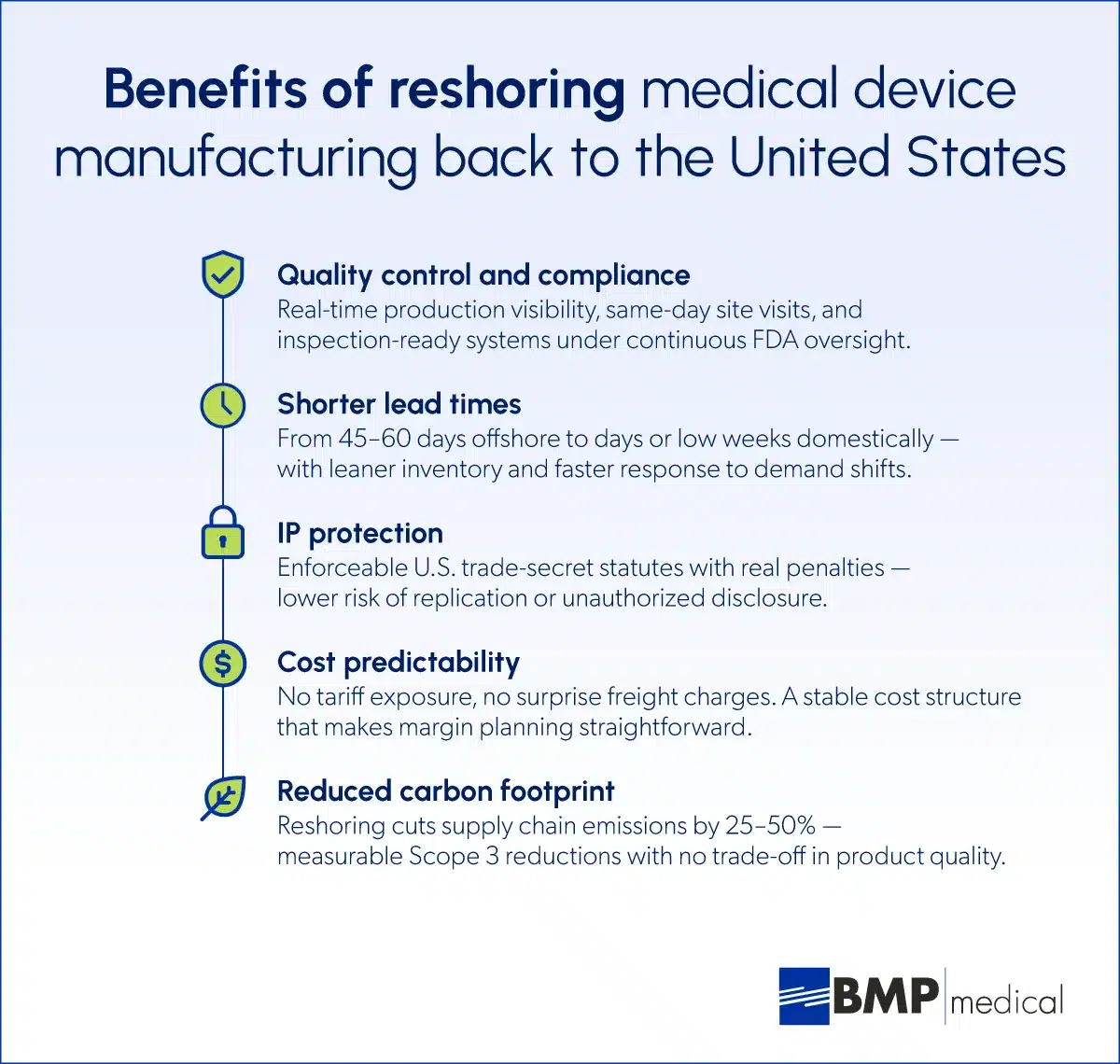
Quality control and quality assurance are paramount to medical device design, development, and manufacturing. Domestic production gives OEMs direct, real-time visibility into every stage of the manufacturing process — from incoming material inspection to final packaging. With a contract manufacturer in the same country, teams can conduct site visits on short notice, participate in audit readiness reviews, and respond to corrective actions within days rather than weeks.
A medical device manufacturing partner that embraces real-time data QMS procedures is better positioned to keep pace with evolving compliance and regulatory requirements. U.S.-based facilities operate under continuous FDA oversight, which means they maintain inspection-ready quality systems year-round.
Several certifications and accredited programs, including MedAccred, FDA compliance, ISO certification, and adherence to cGMP practices, should be considered to mitigate risk.
Supply Chain Management and Lead Time Reduction
Offshore lead times for medical components typically run 45-60 days door-to-door, and that window can stretch significantly during port congestion or geopolitical disruptions. Domestic sourcing compresses lead times to days or low weeks, giving OEMs the agility to respond to demand changes, design revisions, or urgent clinical needs without a months-long lag.
Shorter, more predictable supply chains also mean lower inventory carrying costs. When the manufacturer is a domestic shipment away rather than an ocean crossing, OEMs can operate with leaner safety stock and free up working capital.
IP Protection
U.S. manufacturers operate under enforceable IP statutes and trade-secret protections that carry real penalties. When production happens in jurisdictions with weaker IP enforcement, OEMs face a higher risk of design replication, counterfeiting, or unauthorized disclosure, all of which are difficult and expensive to litigate across international borders.
Cost Considerations
Once production moves stateside, the most immediate financial benefit is the elimination of tariff exposure entirely, a significant line item given that rates on Chinese-manufactured medical components currently sit at 54% [1].
Domestic production also removes the costs that often go unaccounted for in offshore unit-price comparisons: expedited freight to recover from delays, international travel for audits and quality reviews, inventory buffers to hedge against long and unpredictable lead times, and the internal overhead of managing cross-border compliance. For many OEMs, the total cost of domestic manufacturing is not only competitive but also more predictable, making it easier to plan margins and allocate budget with confidence.
Sustainability and Reduced Carbon Footprint
Healthcare supply chains generate an estimated 60-80% of the sector's total carbon emissions [6]. Reshoring initiatives, on the other hand, have the potential to reduce carbon footprints by an average of 25-50% [7]. For OEMs facing sustainability reporting requirements or ESG commitments, a domestic manufacturing partner delivers measurable reductions in Scope 3 emissions with no trade-off in product quality.
Challenges to Consider When Reshoring Manufacturing
The benefits of reshoring medical device manufacturing are substantial, but OEMs should go in with a clear understanding of the transition's practical demands:
Upfront investment
Tooling transfers, process re-validation, and facility qualification add cost and time. FDA change-control requirements typically trigger a revalidation cycle that must be factored into project planning.
Workforce availability
A skilled labor shortage across U.S. manufacturing makes it harder to build capability from scratch. As such, partnering with a contract manufacturer that has an established, trained workforce is the most effective way to sidestep this challenge.
Supply chain realignment
Building new domestic supplier networks is a multi-month effort. A phased dual-sourcing approach, i.e., maintaining offshore production while ramping domestically, can mitigate risk while the new supply chain matures.
The common thread across all three is planning. OEMs that build realistic timelines, budget for re-validation upfront, and partner with an experienced domestic manufacturer consistently navigate the transition with fewer setbacks.
How to Plan a Reshoring Transition
Reshoring a medical device production line is a phased process that typically spans several months to over a year. Here are a few key considerations for OEMs planning the transition:
Conduct a total cost of ownership analysis
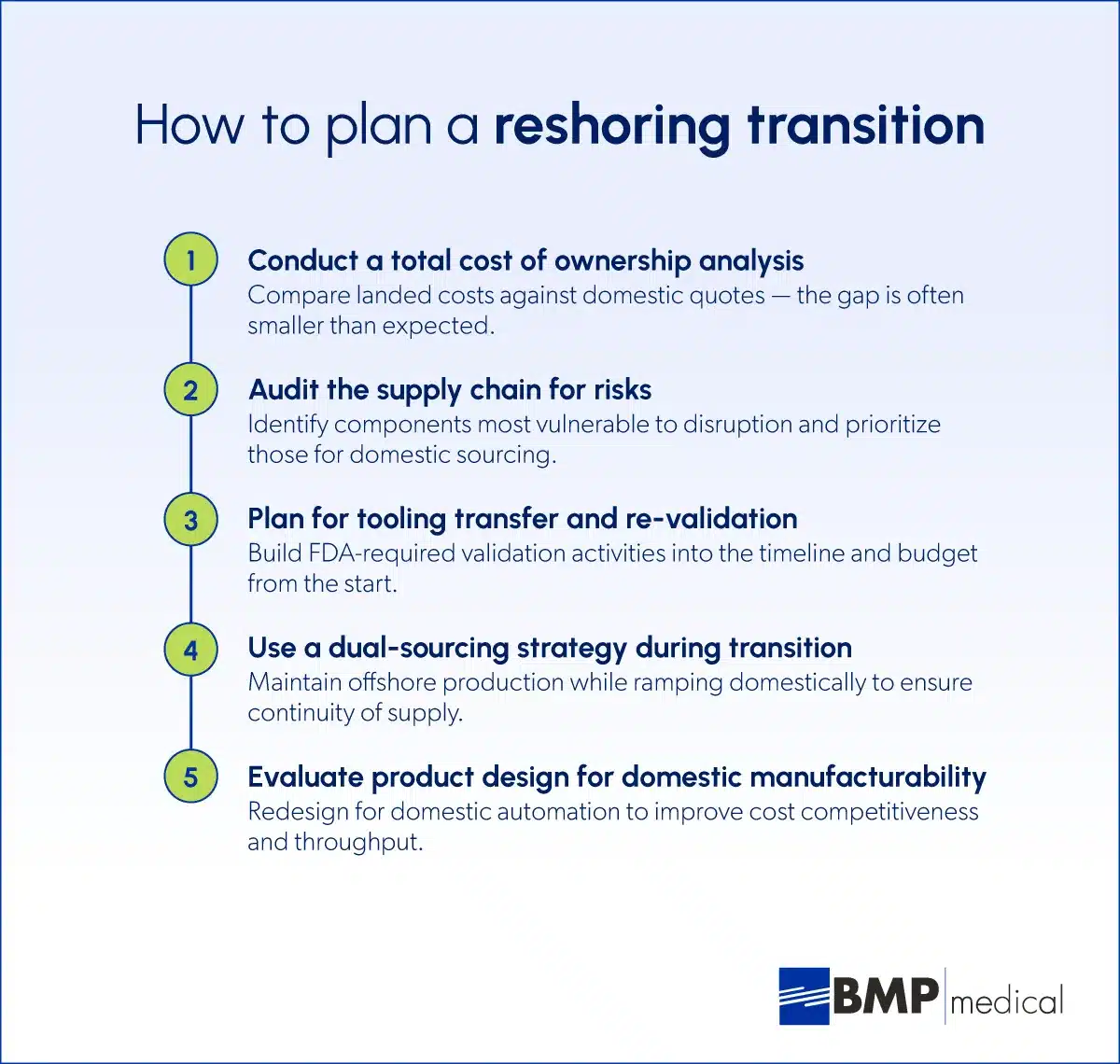
Compare landed costs – unit price plus tariffs, freight, duties, inventory carrying, and quality costs – against domestic quotes. In many cases, the gap is smaller than expected or has reversed entirely once all line items have been accounted for.
Audit the supply chain for risks
Identify which components are most vulnerable to disruption from geopolitical instability, long lead times, or sole-supplier dependence. Then, prioritize those for domestic sourcing first.
Plan for tooling transfer and re-validation
Coordinate with the new domestic manufacturing partner to create a detailed timeline for transferring molds and tooling. Include any FDA-required validation activities in the budgets upfront, and build them into the project schedule from the get-go.
Use a dual-sourcing strategy during transition
Maintaining offshore production while ramping up domestically ensures continuity of supply and provides time to fully qualify the new site without risking stockouts or delivery gaps.
Evaluate product design for domestic manufacturability
Products originally designed for manual assembly overseas may benefit from redesign to take advantage of domestic automation capabilities, further improving cost competitiveness and throughput once production is established.
What to Look for in a U.S. Medical Device Contract Manufacturer
When choosing a U.S.-based medical device and component manufacturing partner, several key factors determine the right fit for your product and business.
Certifications and regulatory track record
Look for ISO 13485:2016, FDA registration, MedAccred accreditation, and demonstrated cGMP compliance. Ask about their history with FDA inspections. A clean track record signals a mature quality system.
Full lifecycle capabilities
It is vital to find a design, development, and manufacturing partner that has the proper equipment, technology, and expertise, and is capable of meeting your production levels throughout the entire product life cycle while maintaining high-quality throughput.
Experience with reshoring transitions
A partner that has managed tool transfers and site validations can compress timelines and help avoid common pitfalls.
Clean room and specialized manufacturing capabilities
Depending on your product class, confirm ISO Class 7 or Class 8 cleanroom availability, as well as specialized processes such as two-shot molding, insert molding, or blow molding.
Communication and responsiveness
Working with a medical device manufacturing vendor in the same time zone that can respond to production changes in a time-sensitive and responsive manner is an added advantage. Even in our digital age, human interaction is a vital component of delivering great customer service.
Why Consider BMP Medical
For OEMs ready to reshore medical device manufacturing, BMP Medical offers a proven domestic partnership built on deep industry expertise and operational excellence.
Located in the United States, with an 80,000 sq. ft. facility in Sterling, Massachusetts, BMP Medical provides plastic contract manufacturing services to leading medical device and diagnostic OEMs in need of injection molding, injection blow, two-shot, and insert molding.
From concept through commercialization, we partner with OEMs to solve complex manufacturing challenges, bringing proven experience across IVD, IV access, sample-preparation devices, lateral-flow technologies, and other medical diagnostic and device categories.
The breadth of capability, backed by a quality infrastructure built for FDA-regulated production, makes BMP a strong fit for OEMs bringing medical device manufacturing back to the United States.
BMP Medical's quality and compliance infrastructure includes:
- ISO 13485:2016 certified
- FDA registered (Registration #1220502)
- MedAccred accredited
- 21 CFR 820 Quality System Regulation compliant
- ISO Class 7 assembly
- ISO Class 8 clean room injection molding, assembly, and packaging
Ready to bring your medical device manufacturing back to the United States? Get in touch with our team today.
References:
- Tariffs on Medical Devices: Global Trade Disruptions in MedTech
- AHA Senate Statement on Trade in Critical Supply Chains
- Frequently Asked Questions: CHIPS Act of 2022 Provisions and Implementation
- J&J expects tariff charge of $400M this year
- FDA Announces Expanded Use of Unannounced Inspections at Foreign Manufacturing Facilities
- Decarbonizing the healthcare supply chain strategic actions for health systems
- Green Powered Reshoring: The Root of Sustainable Manufacturing