
From disposable syringes to implantable components, medical injection molding underpins nearly every segment of modern healthcare, bringing to life the devices clinicians and patients rely on every day.
For medical device companies and OEMs, understanding how this process works – and what to look for in a manufacturing partner – is essential to launching safe, reliable products to market on time and within budget.
Here, we discuss medical injection molding processes, materials, standards, and key considerations that matter most.
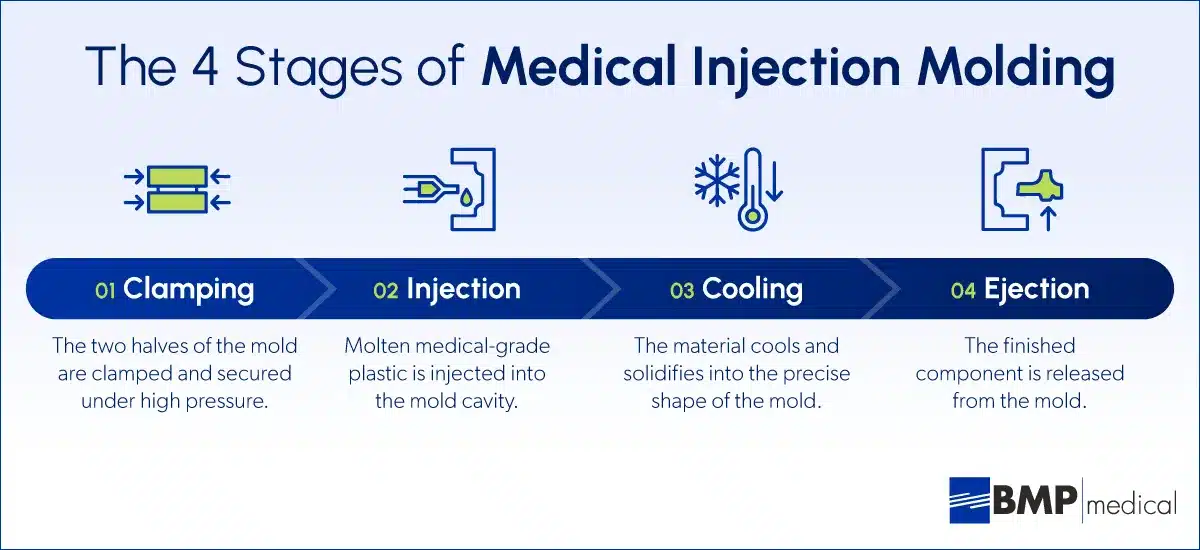
Medical injection molding is a specialized manufacturing process to produce precise plastic components for healthcare applications. It involves injecting heated, medical-grade material into a custom-designed mold. Once the material cools and solidifies, the finished part is ejected, ready for use in medical devices.
Using injection molding, manufacturers can consistently produce parts with complex shapes and structures at high volumes, while maintaining strict tolerances. The medical industry relies on these molded components for a variety of applications, such as surgical instruments, diagnostic devices, and drug delivery systems.
The process follows four core stages:
Medical injection molding vs. traditional injection molding: What sets medical injection molding apart from standard industrial molding is the level of control and accountability required at every stage.
Medical components must meet far tighter tolerances – in some cases down to ±0.001" – and the production takes place under strict regulatory standards inside ISO-classified cleanrooms.
Every single consideration – the material used, the process established, the parameters set, and, of course, the final component produced – must all meet performance standards. Starting from raw material entry to finished part storage, each step must be traceable and documented to meet FDA and ISO requirements.
For medical device companies and OEMs, the injection molding process goes beyond just shaping plastic. It's a critical part of product development that ultimately determines whether the product is safe enough for use in healthcare and consistent enough to be manufactured in millions without even the slightest variation.
There's one reason why injection molding has become the backbone of medical device manufacturing:
No other production method matches its combination of precision, scalability, and per-unit cost efficiency at the volumes healthcare demands.
Consider this: a single local hospital may use tens of thousands of disposable syringes, IV components, and diagnostic cartridges in a given week. Scale that across a mid-sized city with 4 or 5 hospitals, and we're looking at hundreds of thousands of molded components circulating through care settings in just a few days. Medical injection molding makes that kind of high-scale manufacturing feasible.
In addition to volume, another attribute that sets this process apart in the medical injection molding market is repeatability.
For instance, when a surgical component is molded, the ten-thousandth part needs to be dimensionally identical to the first. The margin for error is virtually zero. Injection molding's automated, closed-loop process control makes this level of consistency achievable.
For medical device OEMs and product development teams, this translates into four practical advantages:
Cost efficiency and consistency at scale
High upfront tooling costs are offset by low per-part costs, making injection molding the most cost-effective path to market for high-volume Class I and Class II devices. It also delivers part-to-part repeatability that machined processes simply can't match.
Design complexity
The process accommodates intricate designs and micro-features that would be difficult or impossible to achieve with other methods.
Material versatility
Manufacturers can select from a wide range of medical-grade thermoplastics tailored to their specific requirements, such as biocompatibility, chemical resistance, sterilization tolerance, and optical clarity, without sacrificing performance.
Regulatory-ready production
Compliant record-keeping can be seamlessly built into medical injection molding workflows. The process lends itself to the documentation and traceability required by the FDA and ISO standards.
Simply put, medical injection molding sits at the intersection of design, compliance, and commercial production, making it a sought-after process for bringing medical devices to market.
Medical injection molding touches nearly every corner of healthcare, from simple disposables to highly complex devices.
Here are some of the most common application categories:
Different applications in the injection molding medical industry require different approaches. The right process choice depends on part size, design, material behavior, regulatory classification, and functional requirements.
Here's a quick breakdown of the most common injection molding processes:
| Injection molding approach | What it is | Applications | Key considerations |
|---|---|---|---|
| Micro-molding | A highly specialized process for producing extremely small, high-precision, intricate components with micron-level precision. | Catheter tips, microfluidic devices, hearing aid components, implantable parts, micro-surgical tools | Requires specialized tooling and tight process control |
| Insert molding | A process for molding plastic around a pre-placed component (often metal) to create a single integrated part. | Components with embedded metal contacts, such as needle hubs and threaded fasteners | Precise placement is critical to part quality and performance |
| Overmolding | A secondary molding process where one material is molded over another to create a single integrated part. | Ergonomic grips on surgical tools, soft-touch device housings, and wearable components | Material compatibility between layers must be validated |
| Liquid silicone rubber (LSR) molding | Injection of liquid silicone into a heated mold to produce flexible, biocompatible parts. | Seals, valves, gaskets, respiratory masks, tubing, wearable medical components, and implantable-grade parts. | Excellent biocompatibility but requires specialized tooling and controlled handling |
| Thin-wall molding | Advanced molding to produce lightweight parts with thin walls while maintaining extremely tight tolerances and structural integrity. | Surgical instruments, disposable containers, diagnostic cartridges, and packaging | Requires rigorous validation and monitoring; demands precise injection and cooling conditions |
An experienced medical device manufacturing partner can help determine which approach – or combination of approaches – fits your program. At BMP Medical, we help you choose the right material or consult with our vendors to custom-formulate a polymer blend to best fit your needs.
In the injection molding medical industry, material selection starts with the end use: Will the part be sterilized repeatedly or disposed of after a single use? Does it need to withstand prolonged body contact or mechanical stress? Answers to these questions can help narrow material selection.
Common Medical-Grade Materials
Below are the commonly used medical-grade materials for injection molding across the medical device market:
| Material | Typical use | Why it's chosen |
|---|---|---|
| PEEK | Implantable components, surgical tools | Exceptional strength, heat resistance; replaces metal in some implantables |
| PP (Polypropylene) | Syringes, labware, caps, containers, disposables | Cost-effective, lightweight, versatile, good chemical resistance |
| PC (Polycarbonate) | IV connectors, blood oxygenators, diagnostic housings, transparent parts | Go-to choice when transparency and toughness are both required |
| PE (Polyethylene) | Tubing, fluid management, bottles | Accommodates diverse device requirements, chemical resistance |
| Silicone (LSR) | Seals, gaskets, valves, wearables, catheters | Excellent biocompatibility, sterilization durability |
Biocompatibility Considerations
Any material that comes in contact with the human body – directly or indirectly – must meet biocompatibility standards.
This isn't a single pass/fail test. It's a series of assessments covering cytotoxicity, sensitization, irritation, and more, tailored to the nature and duration of body contact. OEMs benefit from accounting for these biocompatibility requirements early on to avoid regulatory delays.
Sterilization resistance
Medical components must withstand sterilization without degrading or warping. As such, material choice should match the intended sterilization method to maintain both performance and safety.
One of the key advantages of working with a leading medical injection molding company is getting manufacturing consultations early, ideally when the design is still taking shape.
BMP Medical works closely with clients from the design phase through production, ensuring that each component is tailored to meet specific needs. This collaboration starts with Design for Manufacturability (DFM) feedback, where we review part design, wall thicknesses, geometry, angles, and tolerances to catch potential molding issues before they become expensive revisions.
From here, we use rapid prototyping to quickly test and refine products, validating form, fit, and function before committing to production tooling and, ultimately, full-scale production.
Here's what the end-to-end process looks like in practice:
| Concept | DFM Review | Prototyping and Validation | Tooling and Pilot Runs | Full-Scale Production |
|---|---|---|---|---|
| Initial design is reviewed and materials are recommended based on device requirements and regulatory pathway. | Design is evaluated for manufacturing feasibility, identifying potential issues with geometry and materials. | Rapid prototypes are created to test for form, fit, and function, allowing design refinement before production. | Production tooling is built and validated with pilot runs confirming part quality, consistency and process stability. | Seamless transition to high-volume manufacturing with established quality controls in place. |
These sequential steps and timely check-ins reduce the risk of late-stage design changes or mid-program retooling that can expand timelines and budgets.
Medical injection molding companies, like BMP Medical, must adhere to stringent regulatory standards, including ISO certifications and FDA guidelines. These regulations ensure that any product that ends up in or on a patient meets the required safety and performance criteria, which is especially important in medical applications where even minor defects can have serious consequences.
Two regulatory frameworks govern the vast majority of injection molding processes:
Medical components are typically molded in controlled environments to minimize particulate contamination. Cleanroom classifications, such as ISO Class 7 or Class 8, define acceptable levels of particulate counts per cubic meter of air.
Continuously monitoring airborne particulate levels is a non-negotiable requirement for manufacturing medical parts that contact patients, dispense drugs, or require sterile packaging.
From raw material lot numbers to finished components' batch details, regulatory bodies expect detailed records for traceability. This chain of documentation is supported by formal process validation, commonly referred to as IQ/OQ/PQ (Installation Qualification, Operational Qualification, Performance Qualification), which confirms that all equipment and processes perform as intended and the manufactured parts are within specification.
Questions to ask your medical molding and manufacturing partner:
|
The industry is evolving with the integration of new technologies. As medical devices become more sophisticated, molding companies are adopting cutting-edge materials and processes to enhance performance, durability, and biocompatibility.
Advanced polymers: The next generation of thermoplastics expands what's possible – improved chemical resistance, lighter weight, and enhanced biocompatibility – making them ideal for single-use medical devices.
Miniaturization: As medical devices shrink in size, continued innovation in micro-molding enables smaller, more intricate components for minimally invasive point-of-care diagnostics and wearables.
Multi-material and complex part integration: Techniques such as overmolding and insert molding enable more functional, consolidated designs without increasing assembly time.
Sustainability: The medical device industry is beginning to address the environmental impact of plastic use. Recycled and bio-based resins are being used where regulations permit, and processes are being intentionally optimized to reduce material waste and energy consumption.
Automation and process control: Robotics, digital monitoring systems, and data-driven quality control are improving consistency and further propelling large-scale production.
As the medical injection molding market moves toward smaller, smarter, and more sustainable components, the manufacturing partners who invest in these capabilities now will be best positioned to support the next generation of devices.
BMP Medical remains at the forefront of these developments by investing in state-of-the-art equipment and fostering a culture of continuous improvement.
With decades of experience and a commitment to innovation, BMP Medical has established itself as a trusted partner for companies seeking high-quality, reliable medical injection molding services. But what sets us apart isn't just capability, it's how we partner with OEMs.
End-to-end partnership: BMP is involved from early-stage DFM consultation through full-scale production, so there are fewer handoffs and a faster path from concept to market.
Regulatory expertise built in: We are ISO 13485-certified and FDA 21 CFR Part 820-compliant, with cleanroom manufacturing, full traceability, and validated processes as our operating standard.
A team that understands your market: BMP's engineers understand the regulatory and performance demands that medical device companies navigate every day.
Take a look at our success stories.
Our focus on precision, regulatory compliance, and customer collaboration ensures that we deliver solutions that meet the evolving needs of the healthcare industry – whether you're developing a first-generation device or scaling an established product line.
Ready to discuss your next project? Explore BMP Medical's injection molding capabilities.